
Impact
Indeed's UX team named Role Calibration and SmartScreen a reference point for future AI explorations. Presented case to Indeed, Google and Amazon teams.
Overview
Indeed's network and two-sided data advantage positions it as the biggest hiring platform in the world by an order of magnitude. However, candidate quality was the biggest complaint and the top driver of negative NPS on Indeed, yet about 60% of applicants met the posted qualifications. Owning design end to end, I worked with another designer to lead an AI screening workflow that lets employers increase hiring velocity and quality.
RESPONSIBILITIES
Design
Prototyping
Research
Timeline
6 months
Jan-Jun 2025
Team
Design (2)
Research (2)
Indeed Design (2)
HIGHLIGHTS
Problem | 01
Indeed's marketplace
Job seekers
profiles
~150job seekers for every employer
~17job seekers for every open job
Job listings
Employers
Problem | 01
Low candidate quality is the biggest NPS driver
#1
41%
4,000+
Problem | 02
AI was built to help with speed and quality but EMPs found its output unreliable
When both sides of the marketplace uses AI
CandidatesTailor resumes with AI
AI writes
Strong match
The pileResumes written by AI, ranked by AI
EmployersScreen large applicant pools with AI
AI ranks
ResultMore AI on both sides made resumes look stronger, but not easier to trust.
Teams felt responsible for good hires that AI "auto" reject
AI summaries were meant to speed up decisions but fewer than 20% of EMPs use them. People stop using automation they don’t trust, even when it could help. Hiring teams didn’t want AI to reject candidates for them because they were accountable for every person they passed on.
Measured against Microsoft’s Guidelines for Human-AI Interaction (Amershi, CHI 2019), global "summaries" missed 3 criteria that matter most for trust: they didn’t show why the AI decided (G11), didn’t let people correct it (G9) and didn’t let teams choose how much it did (G17).
Solution
A proactive AI-assisted workflow that validates teams' priorities before automated screening
01 · Role Calibration
A quick intent check that turns hiring goals into structured criteria for AI matching.
02 · SmartScreen
AI-powered widgets to correct matching, verify resumes and compare tradeoffs.
03 · Candidate Resume View
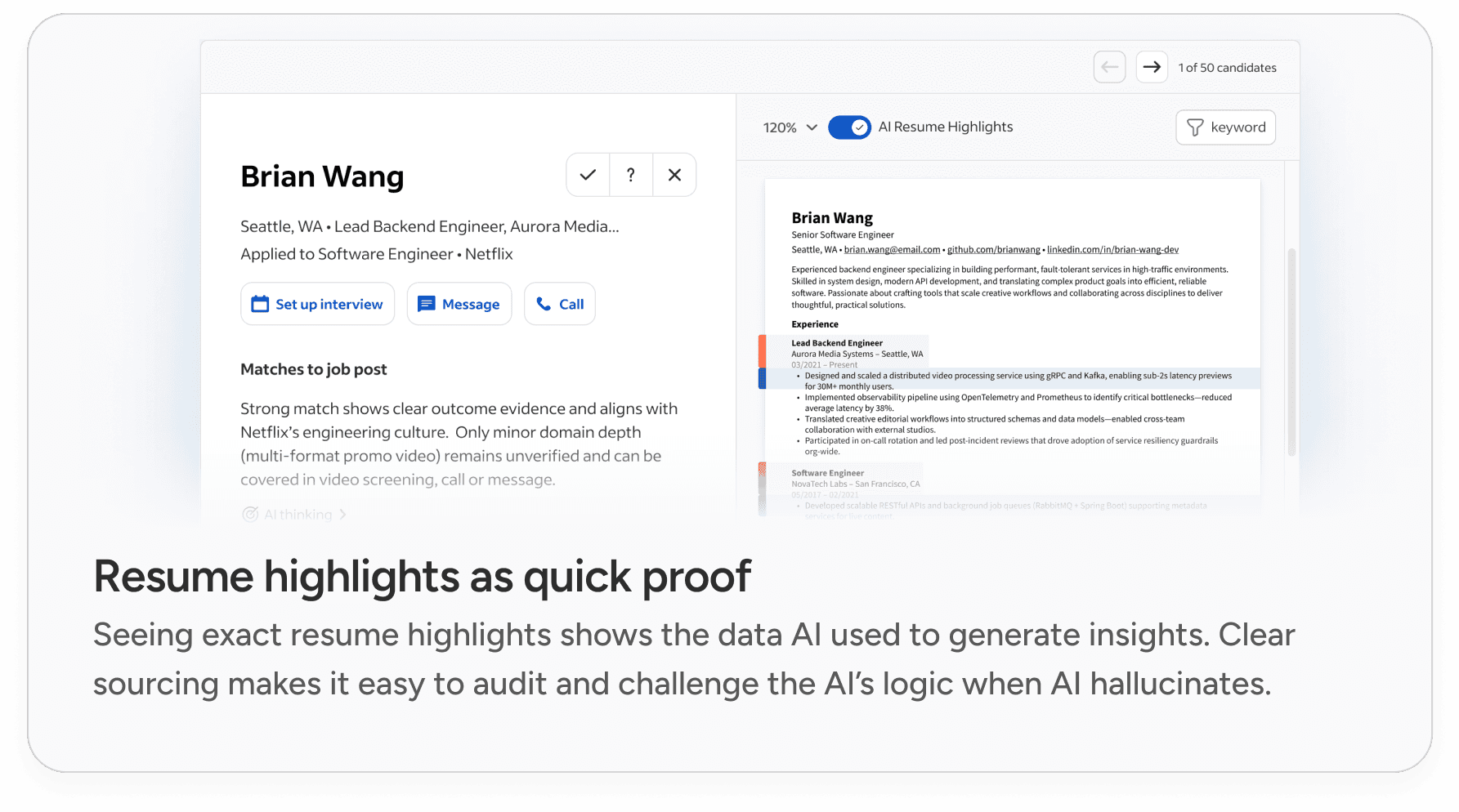
Every AI claim points back to the resume line behind it.
SOLUTION · 01
Role Calibrator
WHY
Capture better, more relevant context from EMPs
AI can match candidates to a prompt, but it can't decide which priorities matter most to a hiring team.
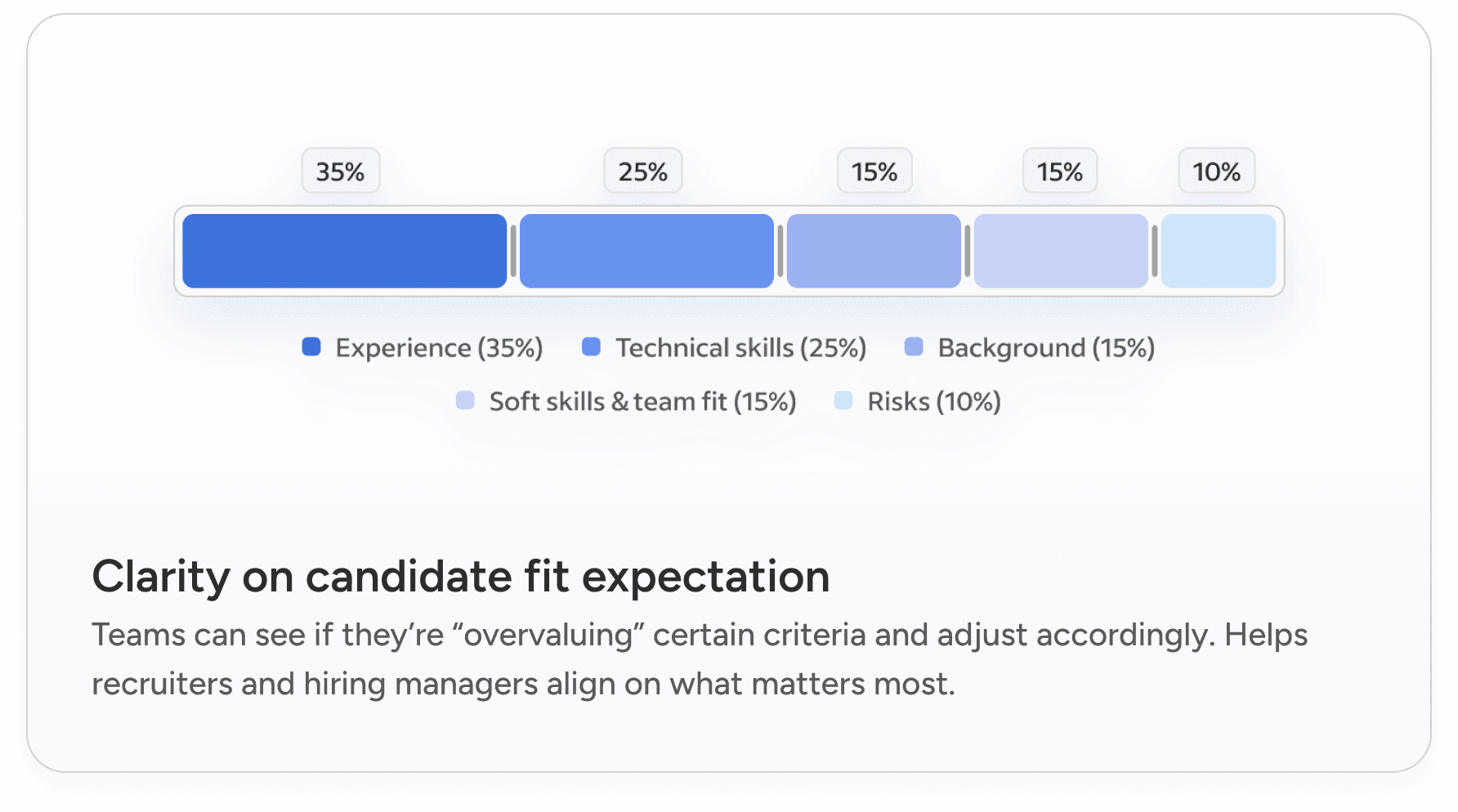
Role Calibration connects Indeed's job creation workflow to priorities that live outside the job post: team notes, market data and hiring preferences. These information increases relevancy. Recruiters set baseline minimums, soft skills, team fit and risks. This captures constantly changing operational context that job materials leave out, bringing more specificity to future model training data.
Confirm & correct what AI has interpreted
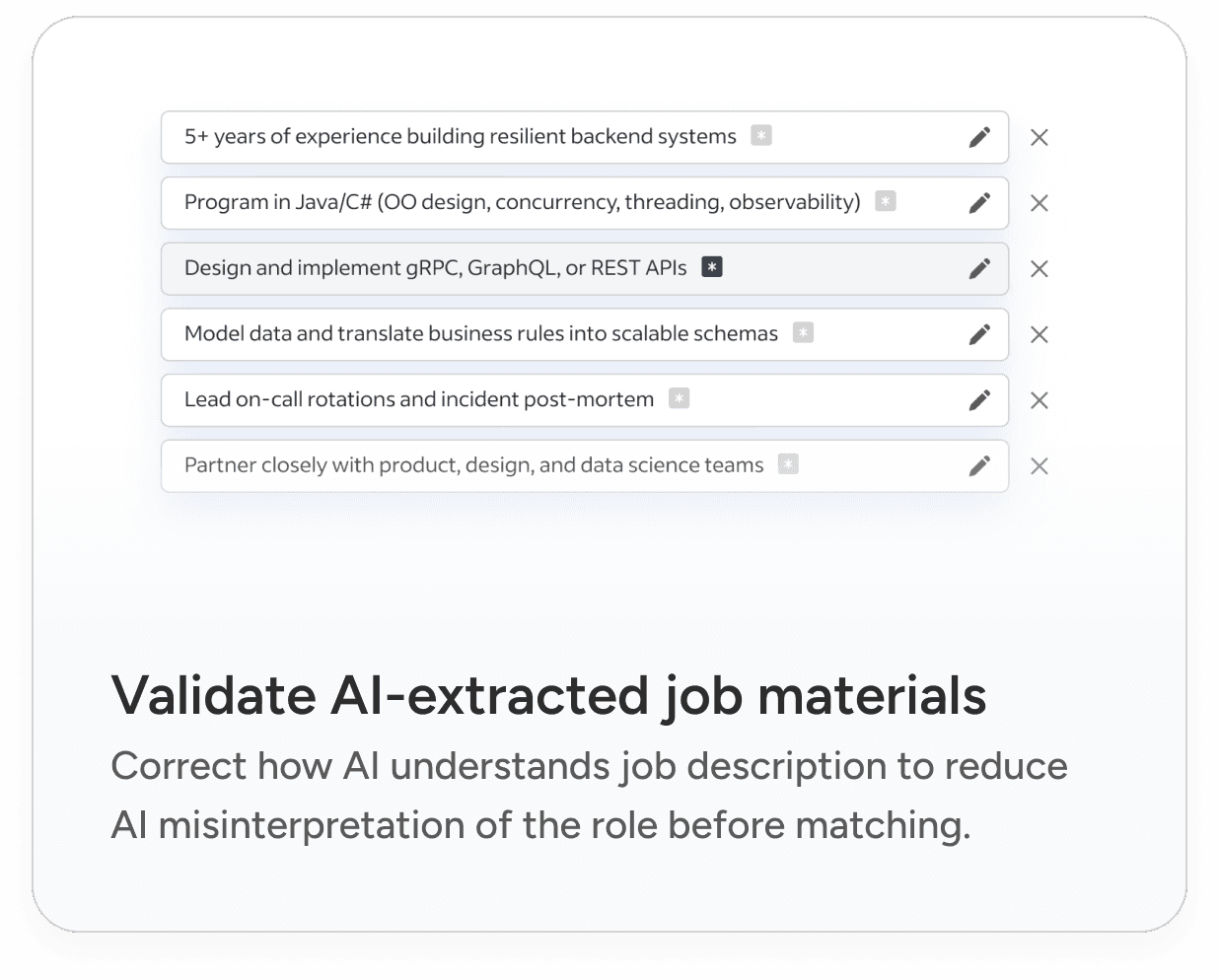
AI turns attachment into bulleted criteria, each traceable to the files. Before matching begins, EMPs can confirm at a high level. "Am I happy if AI said 3-5 things about this role?" and fix anything AI interpreted incorrectly.
Adjust how much each hiring signal counts for matching algorithm
Name your "fit" before AI assumes it
Technical skills tends to be where AI-polished resumes look most alike, echoing keywords in job post. What separates candidates is how they work and that rarely makes it into a job post. Only the hiring team knows the soft skills it needs.
For Indeed, team fit preferences are data no job post holds, and they’re specific to each business unit. Each calibrated role sharpens matching, improving one-shot results.
Because the shortlist reflects criteria the team set themselves, I expected AI shortlist use to climb from <20%. I’d measure shortlist-to-interview rate, resumes reread per hire and repeat job posts.
SOLUTION · 02
Smart Screen
Filter
Screen
Compare
Why
Trust can be proved through evidence that EMPs can validate in seconds
What
Let the evidence prove trust
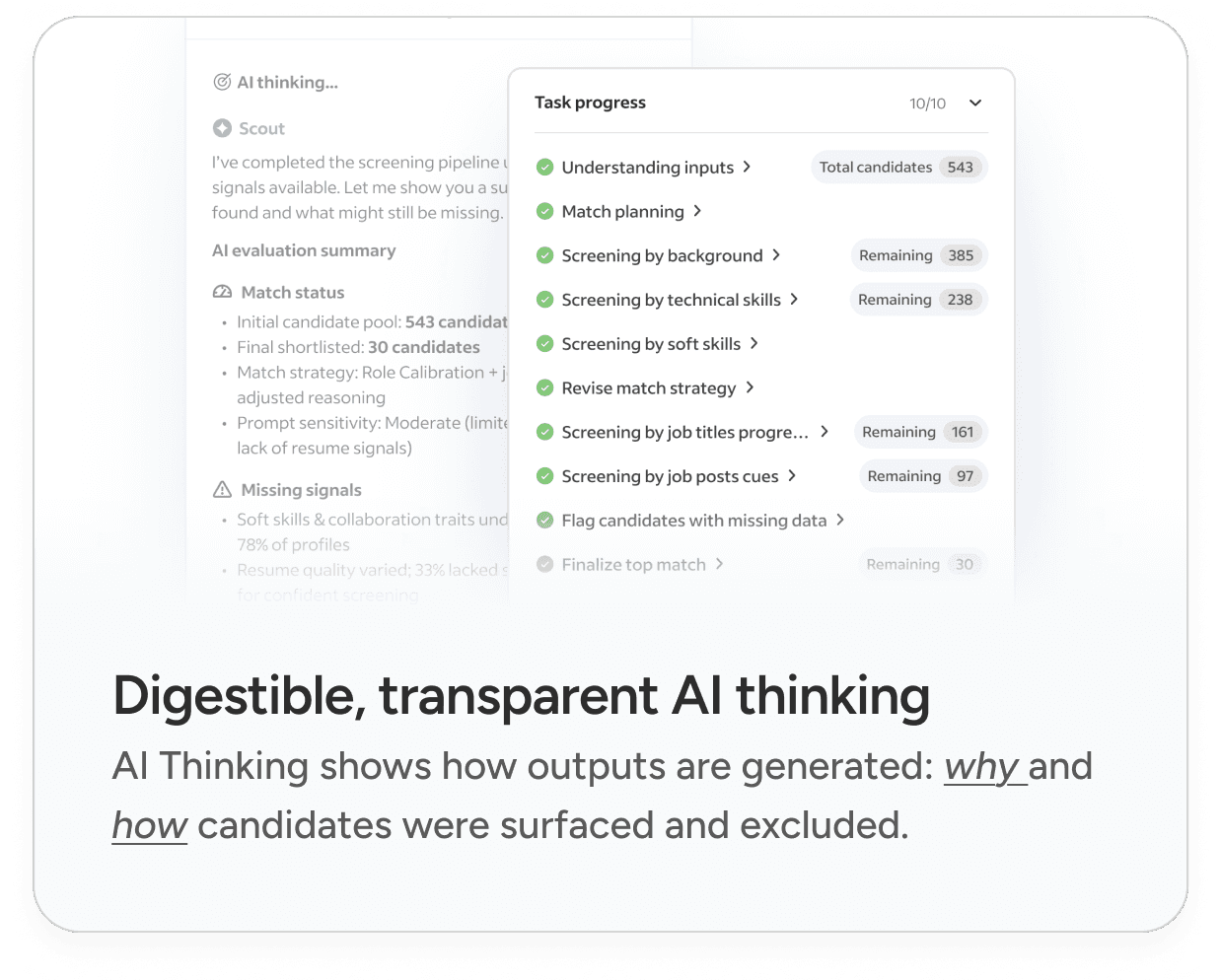
SmartScreen shows which signals AI uses, how each filter applies and how many hires every AI step removes. EMPs compare match strategies and verify claims against external data signals.
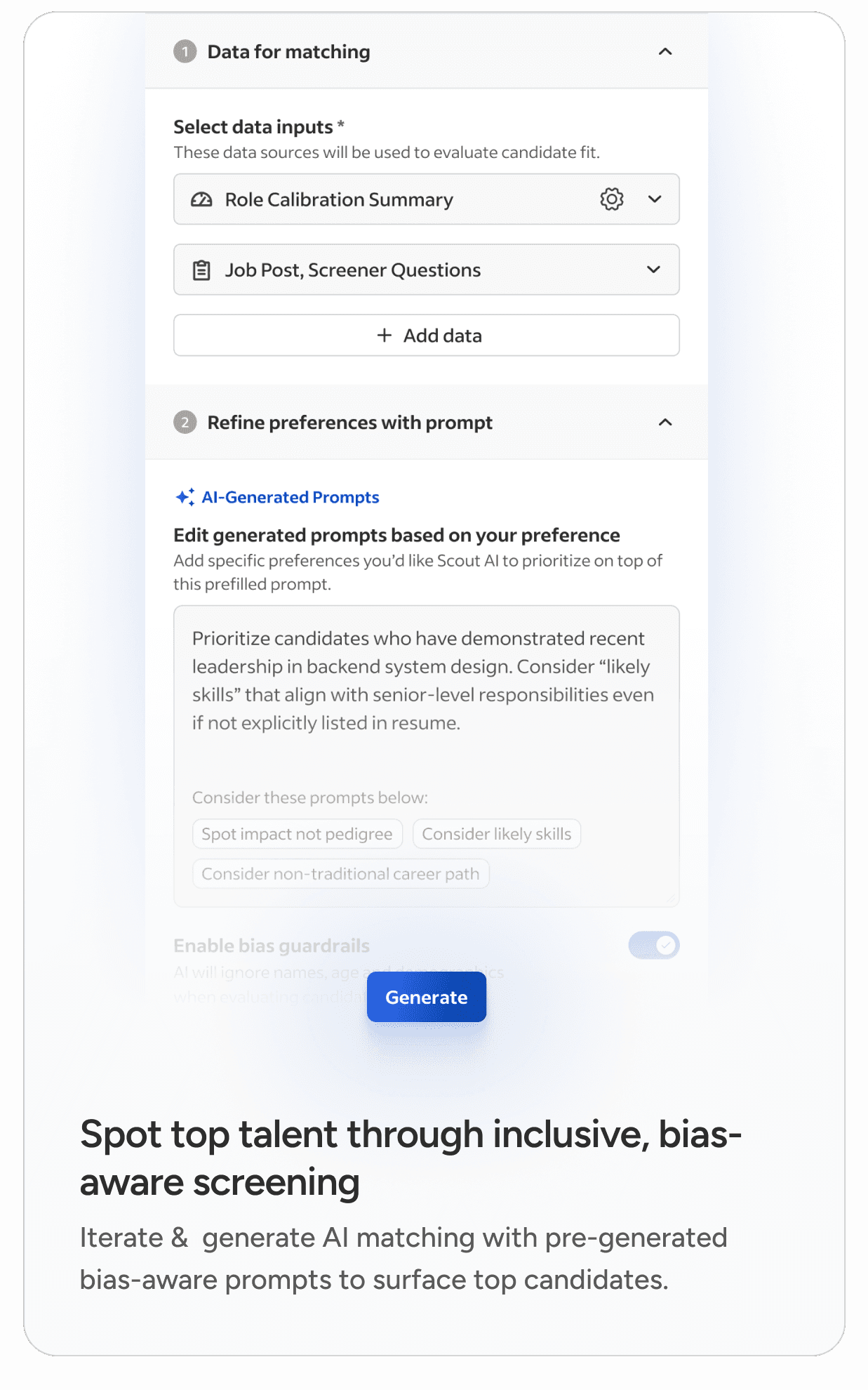
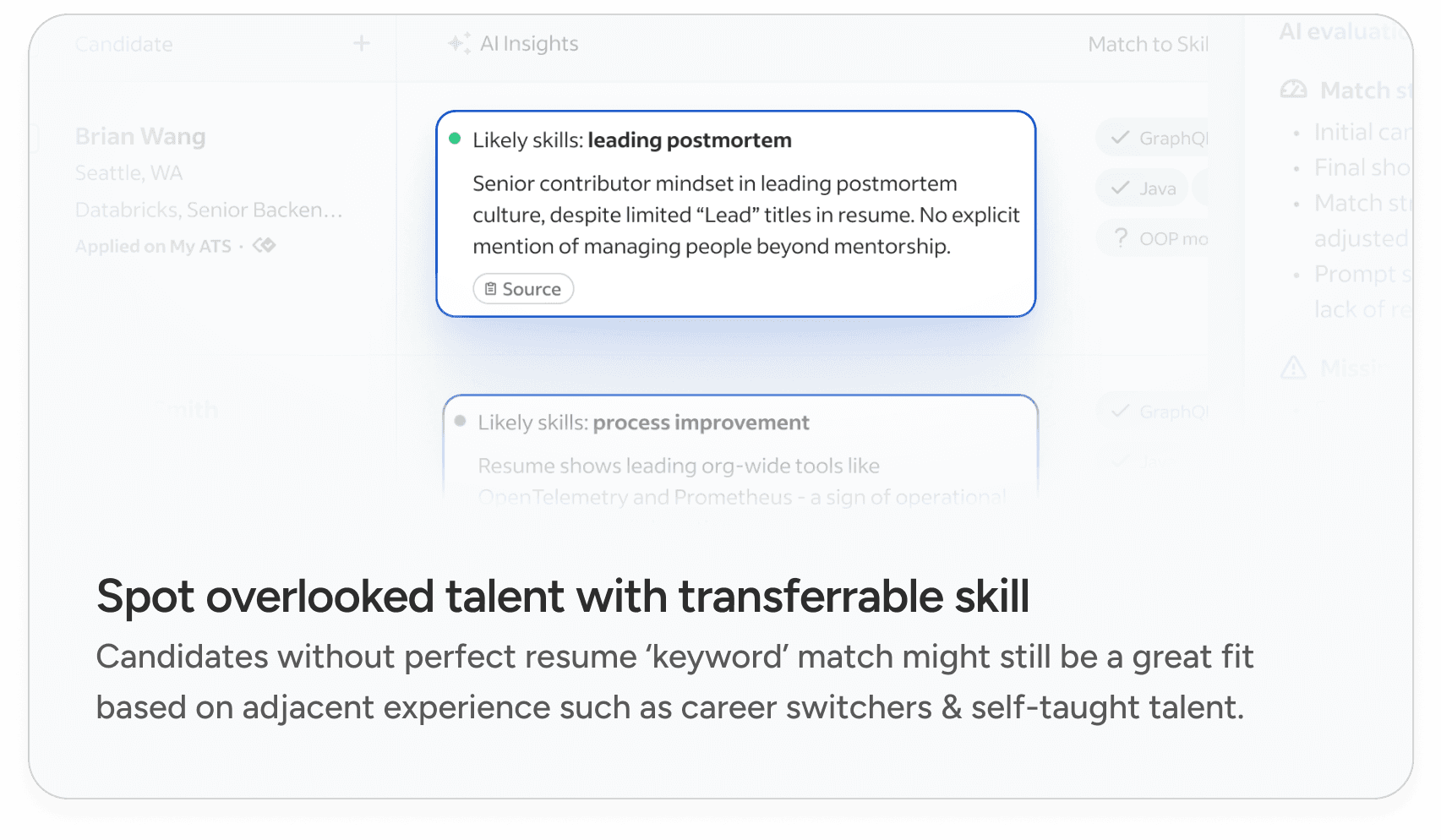
SmartScreen turns Role Calibration inputs into a prefilled prompt. EMPs refine it with suggestions like “Spot impact not pedigree,” and the shortlist reranks instantly with Indeed's bias guardrails on. Most resumes in the market now echo the job post because of AI but each candidate’s mix of experience is unique. Prompting for likely skills surfaces that mix where a generic summary would flatten it.
Bulk compare candidate pool to uncover your decision tradeoffs
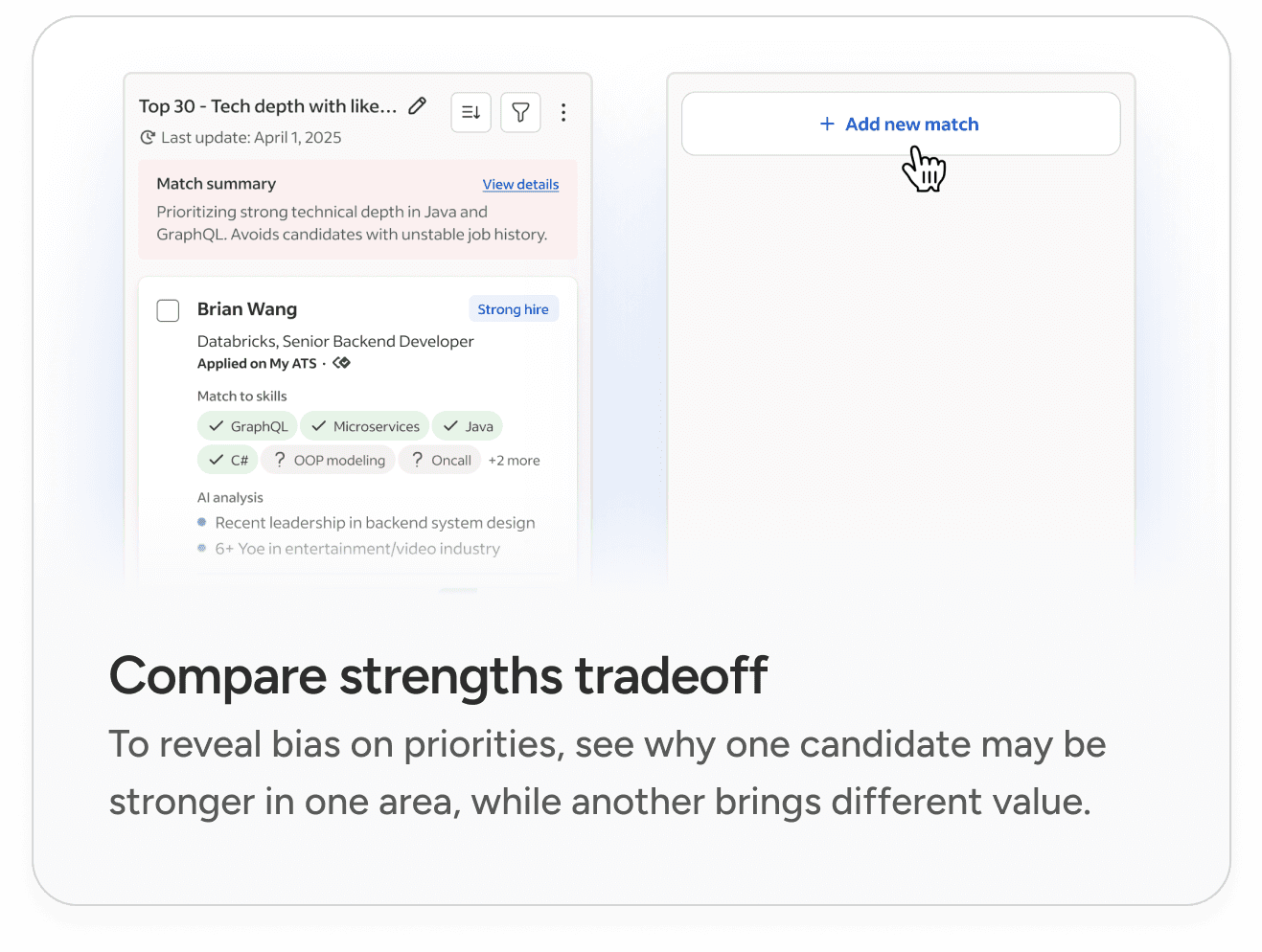
Comparing candidates one at a time gets slow at high volume scale. SmartScreen lets EMPs compare whole pools at once and see who rises, who drops and who appears in only one.
Clicks and applies are signals every job board collects. A hiring manager choosing between 2 weighted pools shows an expert trade-off, like “leadership over pedigree.” Each choice also gives Indeed preference data edge no competitor has.
Validate resume through external data signals
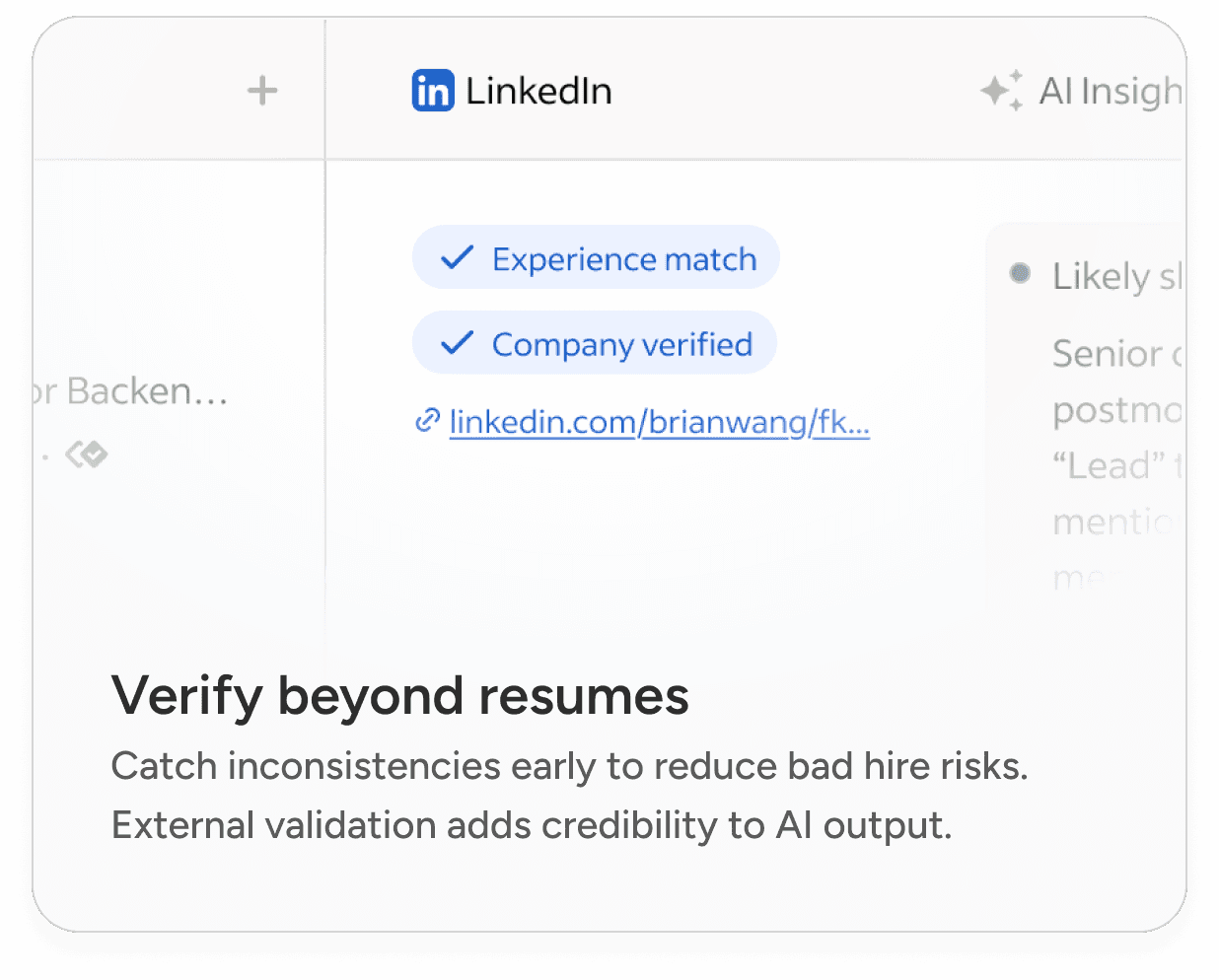
EMPs verification tested very well because it helps EMPs catch exaggerated skills or false identities early. This concept works by initiating it from the demand side: jobseekers-permissioned sharing.
LinkedIn launched Verified on LinkedIn in April 2025 to improve online trust and authenticity.
Members can carry their LinkedIn-verified identity, workplace and education to partner platforms. Current partners are Adobe, G2, TrustRadius and UserTesting. None are hiring platforms yet, which makes this a true engineering partnership opportunity for Indeed.
Collect granular feedback behind rejections
Resumes are auto-highlighted to show the experience AI used to rank each candidate. EMPs check the source of truth without leaving Indeed, and recruiters finalize decisions without rereading resume top down.
We also recommend collecting granular feedback from EMPs to teach the model what "quality" means. Over time, that feedback data improves Indeed’s AI loop and makes first-pass rankings more accurate.
Research
How do businesses of all sizes hire?
1
Employers carry a mental model of the ideal candidate.
But it's hard to articulate into a job post and templates miss the nuance. Over 90% of users reuse old JDs that may be outdated/misaligned.
2
Matching isn't about perfection.
EMPs want help spotting potential, breadth and transferable skills. Exact keyword matches miss these.
Recruiter at a big tech company (P7)
3
Employers need to calibrate their trust in AI. Trust in AI has to be earned and calibrated.
Without AI, EMPs judge by candidate quality and time to hire. With AI, the system also has to show why someone surfaced and let EMPs override it."Calibrated trust" means trusting AI exactly as much as it deserves: more when it’s usually right, less when it’s often wrong.
4
What changes with size is who decides and how fast.
At larger companies, recruiters screen and hiring managers decide, so context gets lost in handoffs. Smaller and hourly teams hire at higher volume with fewer people, so speed matters more than detail.
WHAT EMPLOYERS NEED
What do teams need to hire well?
01
Define what a quality hire looks like
02
Find strong fits beyond keyword matches
03
See why AI picked someone, and correct it
+AI
Final pick: you
04
Move fast alongside teams without losing control or context
8
interviews with recruiters and hiring managers, from big tech to pharma and aviation
1,000+
Reddit posts from job seekers and hiring teams
20+
studies on bias and fairness in AI hiring




4
products compared: LinkedIn, ZipRecruiter, Rippling, Tezi
Our 2 researchers led the literature studies and the Reddit analysis.
We worked alongside them to scope what design could take on.
RESEARCH Synthesis
Why do teams struggle to find high-quality talent: is it the process or the algorithm? Both.
We sorted every pain point by where it starts. Many begin before the algorithm runs, in how the role gets written and assigned to teams.
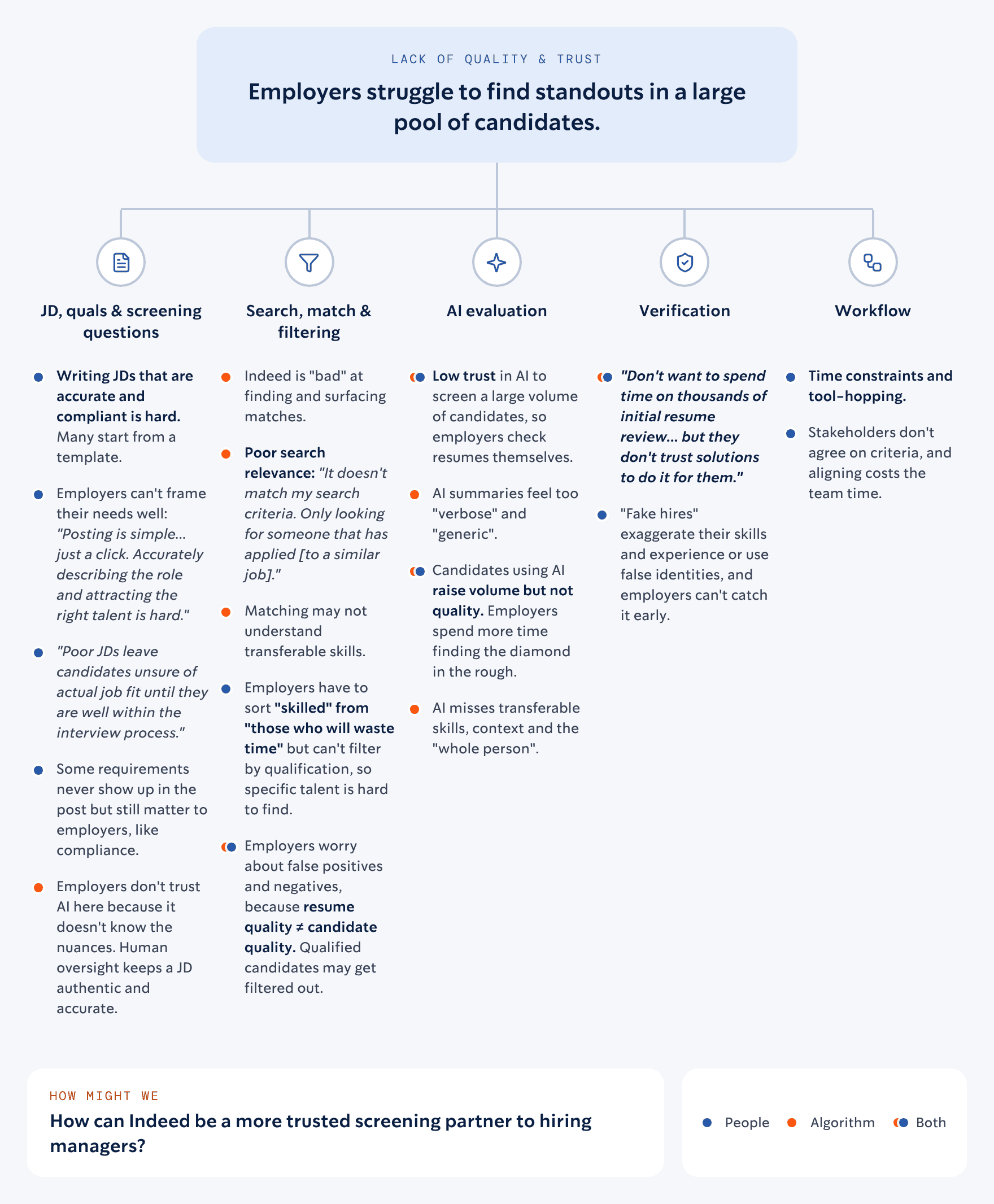
The hiring journey
Lack of understanding
AI can't capture the candidate employers have in mind.
Lack of transparency
Employers don't know the reasoning behind AI results.
Lack of control
Employers have no way to correct AI results.
Employers still read every resume for screening.

Check everythingReread every resume. AI saves no time.
Calibrated trustSpot-check the evidence, override when needed.
Trust blindlyStop checking. Asleep at the wheel.
Synthesized from interviews, Reddit and literature.
DESIGN ASSUMPTIONS

Ideation
AI compresses sourcing and candidate reachout, giving HM time on judgment: qualifying, interviewing and closing.
Where does hiring slow down most? At the top of the funnel. Our workflow map showed the essential tasks cluster in Find and Screen. Speeding up these steps gives HMs more time with candidates. Job seekers would hear back sooner. EMPs would have more time to judge fit.
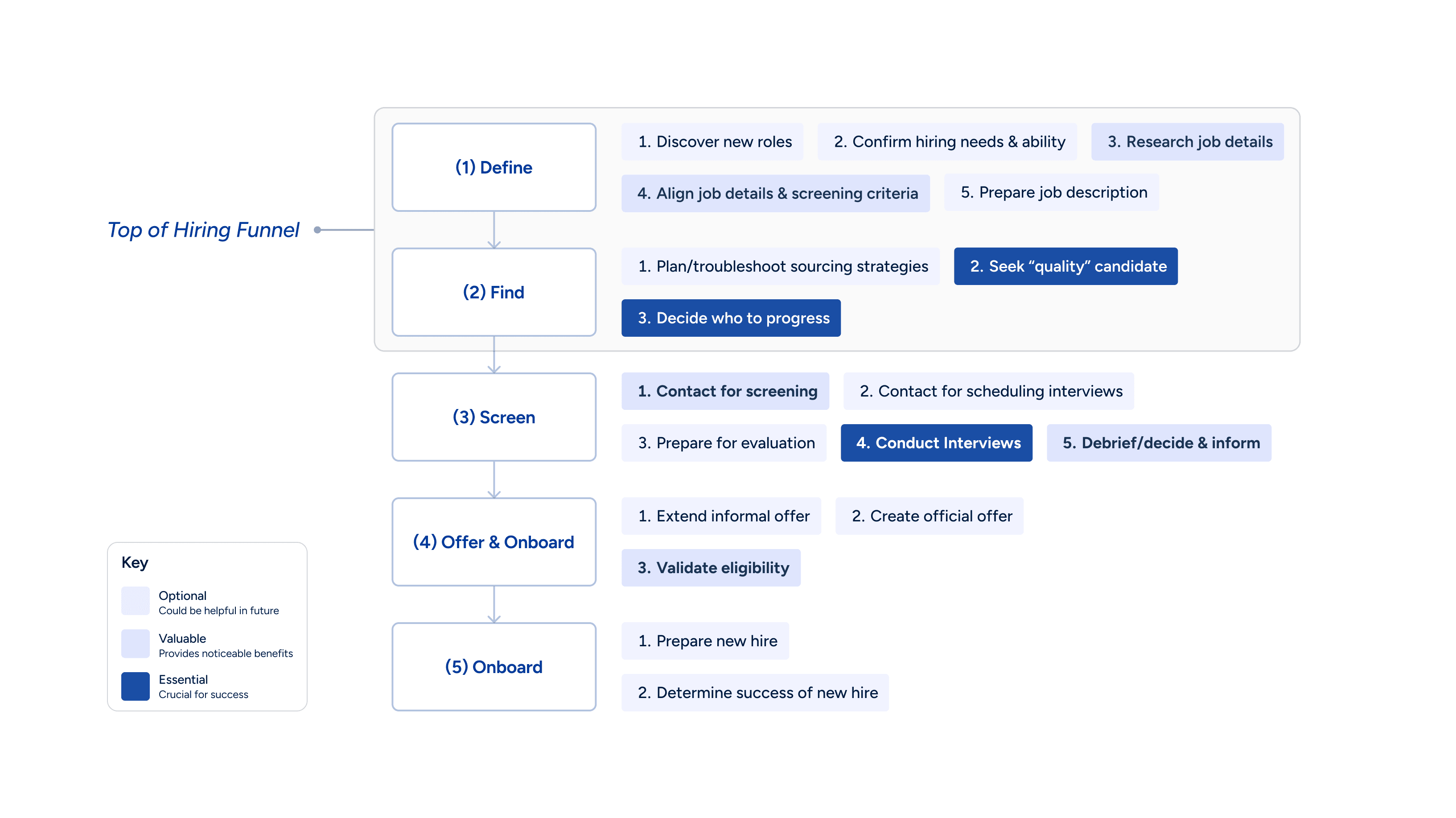
Indeed's Hiring Journey Map | Opportunity Evaluation
For ideation, we focused on 2 questions:
DESIGN QUESTION 01
How might we help employers articulate their needs better?
#1 Candidate persona
#2 Outcome check
#3 JD edit suggestions
#4 Role calibration
DESIGN QUESTION 02
How might we give employers transparency and control over matches?
#4 Pool-based qualification
#5 Maybe candidates
#6 Summary with resume citation
#7 Customize AI screening on result
#8 External data enrichment
Opportunities · decisions · RISKS
Pressure-testing concepts for key revenue drivers: large scale hiring teams.
The matching model itself was outside our scope, which left one question: what can design do when the model’s accuracy isn’t in our hands? Our answer was to make AI’s reasoning visible and its results correctable. The biggest untapped revenue, a $675M segment, sits with satisfied HMs and proactive partners, therefore our primary users are hiring managers and the recruiters who work with them.
Growth opportunityEst. Indeed revenue
$675M
Satisfied hiring managerHiring managers
$470M
Proactive partnerCollaborative partners
Source: Indeed. Estimated revenue and growth opportunity by employer segment.
Over-Automation on the Wrong Stages
The riskiest move is letting AI interpret a job description with no human judgment. Many job descriptions start from a template and what HMs actually needs often isn't in the post. AI reads the words literally, ranks every applicant on them, and a shortlist built on the wrong criteria looks just as confident as a right one.
AI reads it alone
AI drafts, employer confirms
Job description
Data AnalystFrom a template5+ years of experienceAdvanced SQLBachelor's degree required
CriteriaSet by AI
5+ yearsSQLBachelor's degree
Coaches junior analystsWhat the manager needs. Never in the post.
Shortlist248
Strong match
Strong match
Strong match
Confident, but ranked on the wrong signalsCriteriaConfirmed
5+ yearsSQLBachelor's degreeCoaches junior analysts
Employer edits once, before rankingShortlist12
Evidence
Evidence
Evidence
Every match points to a resume lineDesign Principles to Avoid Over-Automation
HCI research suggests automation should vary by stage. Gathering and sorting information can be highly automated, while high-stakes decisions need people involved. Defining what a good hire looks like is one of those decisions. Principle should be automating repetitive stages and augmented the ones that need judgment.
Design Decisions and Our Trade-offs
Optimizing the top of the funnel
over the whole hiring funnel
When we rated each hiring task by how much AI could help, the high scores clustered in Find and Screen. We explored a little bit of offers and onboarding stage, but that would ignore the distrust problem caused by AI.
Visible automation
over full automation
We automated filtering and verification while giving employers flexibility to see and edit every step of algorithmic matching.
Checkable evidence
over a complete explanation
We couldn't change how accurate the Open AI x Indeed model is. So instead of explaining everything, each claim points to a resume line employers can check in seconds.
Fewer calibration steps
over finer control
Round 2 found the flow redundant. Employers now confirm the criteria once instead of tuning each one.
Testing
We tested in three rounds with 14 participants: co-design (3), concept tests (5) and validation (6).
parsed signalsskills that match your notes
Their own words
"Parsed" and "signals" confused them. Use hiring language.
1
Where it came from
"Not sure where the summary came from." Show the source of every AI output.
92% match
A quick read first
They still rank candidates. A match score up top, evidence one click away.
What we changed in round 3 sits with each feature, under User validation.
MVP Milestone
Q1
Q2
Q3
Q4
Phase 1
Phase 2
Phase 3
Phase 4
Phase 1 · Q1Build the core flowRole Calibration, SmartScreen and Resume View with Indeed recruiters.
MVP metrics
AdoptionAI summary use above 20%
TrustShortlist kept on first try · More thumbs up on AI
QualityFewer quality complaints in NPS
OutcomeMore successful hires
Limit: 14 participants, mostly from larger companies. High-volume hourly hiring is untested.
Reflection
Helping one hiring team decide is different from automating thousands of workflows. HCI researcher Ben Shneiderman (2022) argues the best AI systems aim for high automation and high human control at the same time. Our concepts built the control first partly because during the research phase, we focused on explainable AI, not the repercussions of automation. Scaling automation is the next step.
PRODUCT VIDEO